A software development process should be easy to follow, and most software horror stories share the same plot. The price keeps moving. The team goes quiet for weeks. The launch date slides, then slides again. By the end, the client has spent more than planned on something that does less than promised.
The fix is not luck. It is a process built around agreement, visibility, and accountability. Below is exactly how a project runs at Icoweb, from the first conversation to long after launch, and what you should expect at each stage.
Why software projects go over budget and behind schedule
Before looking at our process, it helps to understand the usual causes. Most overruns trace back to a few common problems:
- The scope was vague when work started, so every new idea became a change request.
- Decisions were made late, after code was already written, which made changes expensive.
- The client had no regular view of progress and found problems only at the end.
- Responsibility was split across several vendors, so nobody owned the final result.
A sound software development process addresses each of these directly. It settles scope early, moves decisions to the cheapest stage to change, shows real progress often, and keeps one team accountable from start to finish.
Step 1: Discovery, where you agree before anyone builds
Every project starts with a one- to two-week discovery sprint. We learn your business, define the scope, and agree on the deliverables, the timeline, and the budget before any design or code work begins.
This is where the price gets fixed. We do not start building against a vague idea and bill you for the gaps. By the end of discovery, you know what you are getting, when you will get it, and what it will cost.
Good discovery also answers practical questions: who will use the product, what problem it solves first, which features can wait for a later version, and how success will be measured. Clear answers here prevent most of the arguments that come later.
Step 2: Design, where you approve every direction
Next we move through wireframes, prototypes, and high-fidelity designs. You review them at every step, and nothing gets built until you approve the direction.
This matters more than it sounds. Changing a screen in a design file takes minutes. Changing it after it has been built can take days, and it often affects other parts of the product. Catching decisions at the design stage is where we save you both time and money.
Designs also give non-technical stakeholders a concrete picture to react to. It is much easier to say "this button is in the wrong place" when you can see it than to judge a feature list on paper.
Step 3: Development, in two-week sprints with live demos
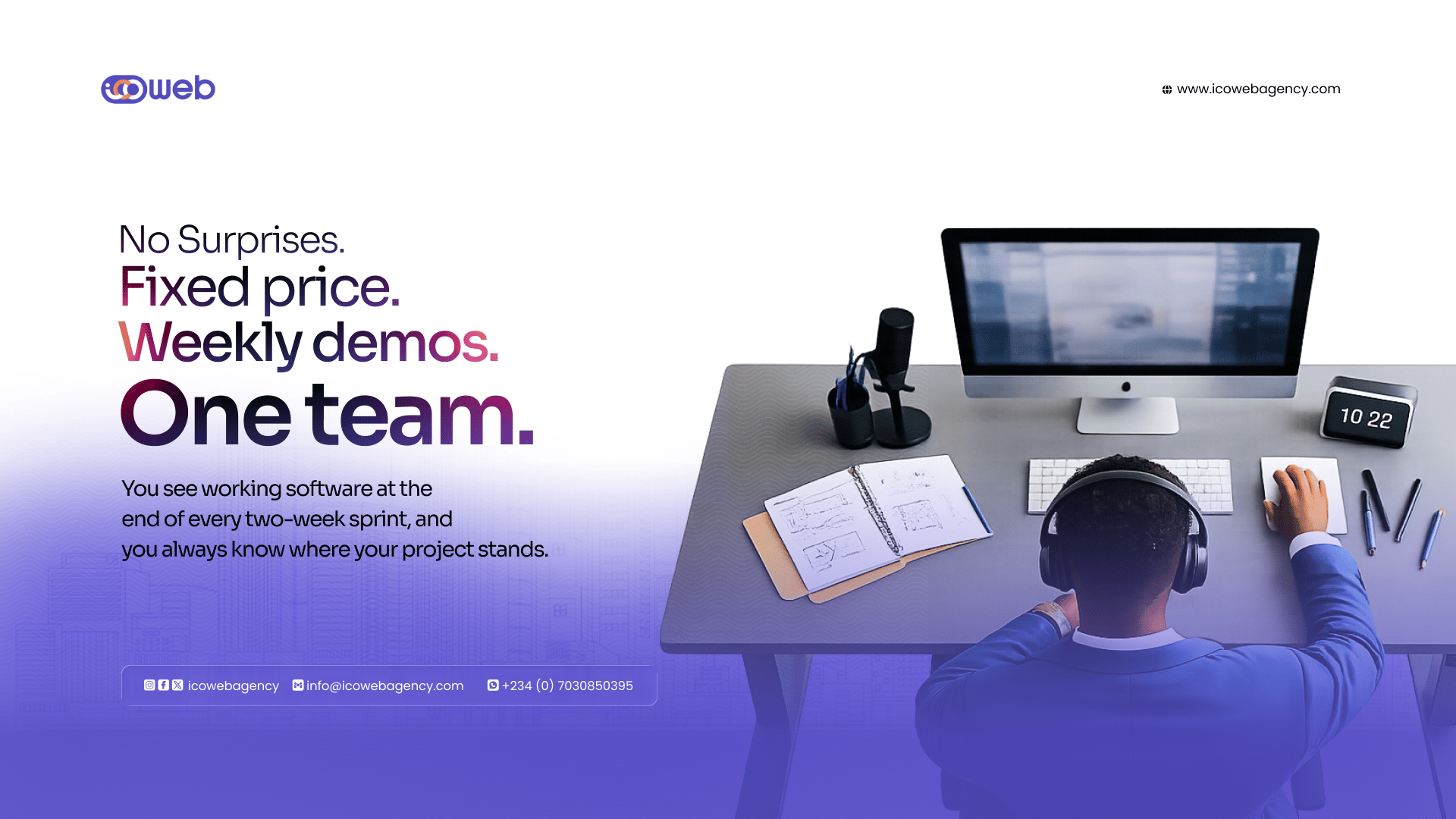
Your product is built in two-week sprints. At the end of each one, we show you the actual software running, not a status report. You can click through it, test it, and tell us what needs to change.
That rhythm is the heart of a predictable software development process. You see real progress every two weeks. If something is heading the wrong way, you catch it while it is still cheap to fix. You are never left wondering what is happening, and you are never shocked at the finish.
Sprints also make priorities visible. When a new request comes in, we can show you what it would displace, so the trade-off is a decision you make with full information rather than a surprise on the invoice.
Step 4: Launch and support, because launch is the start
When the product is ready, we run thorough quality assurance, performance testing, and a controlled deployment. Every project includes 30 days of post-launch support to catch anything that only shows up once real users arrive.
Beyond that, we offer ongoing monitoring, security patches, performance work, and updates. Each ongoing arrangement has a dedicated point of contact and agreed response times, so you know who to call and what to expect. Launch is the beginning of your product's life, not the end of our relationship.
If you want to see how this stage fits the wider work we do, our services page covers the mobile apps, websites, and custom software we build.
What ties the software development process together
Through all four steps, one thing stays constant: you work with one team. Design, development, and deployment sit under one roof, with no subcontractors and no handoffs between vendors. The people who start your project are the ones who ship it and the ones you call afterward.
That structure is what makes the process work. Fixed scope and budget set at discovery, weekly visibility through live demos, and one accountable team together mean you always know where your project stands. The process is how we work every time, not a promise made only at the sales stage.
What to ask any software team before you start
Whether you choose Icoweb or another studio, these questions will show you how mature their software development process really is:
- Will the scope and budget be agreed in writing before design or code begins?
- How often will I see working software, and can I test it myself?
- Who will own the project from start to finish, and will any work be subcontracted?
- What support is included after launch, and how quickly will problems be answered?
- Who owns the source code and the accounts it runs on once the project is delivered?
Clear answers to all five are a good sign. Vague answers, especially on scope and ownership, are a warning worth taking seriously.
Frequently asked questions
How long does a software development project take?
The timeline depends on scope, complexity, and how quickly decisions are made. Discovery usually takes one to two weeks, and development then runs in two-week sprints with a live demo at the end of each one. We confirm the full timeline during discovery, before design or code begins.
Can the scope change after the project starts?
Yes, but changes are handled openly. Because we demo working software every two weeks, you can see the effect of a new request and decide whether to add it, defer it, or swap it for something else. Any change to scope or budget is agreed in writing before the work happens.
What happens after the app or website goes live?
Every project includes 30 days of post-launch support to fix issues that appear once real users arrive. After that, ongoing monitoring, security patches, performance work, and updates can be arranged with agreed response times. Our frequently asked questions page covers more detail on support.
Why does design come before development?
Design is the cheapest stage at which to change direction. A change to a screen in a design file is quick, while the same change after development can affect many parts of the product. Approving designs first means the code is built against decisions you have already signed off.
Every software project carries some uncertainty, but a well-run software development process keeps that uncertainty small and visible. If you have an idea and want to see how this works for your business, start a project brief and we will be in touch to talk through next steps.