If you build with AI coding agents, your Mac probably looks like ours does by mid-afternoon: Claude Code working on a feature in one Terminal tab, another session refactoring something in a second window, Codex running a chore somewhere else, two dev servers on ports you no longer remember, and a Docker stack humming in the background. One of those agents has been waiting for an answer for twenty minutes, and you only find out when you go looking.
We built Taki to fix that for ourselves, and today we are releasing it as open source under the MIT licence.
What Taki does
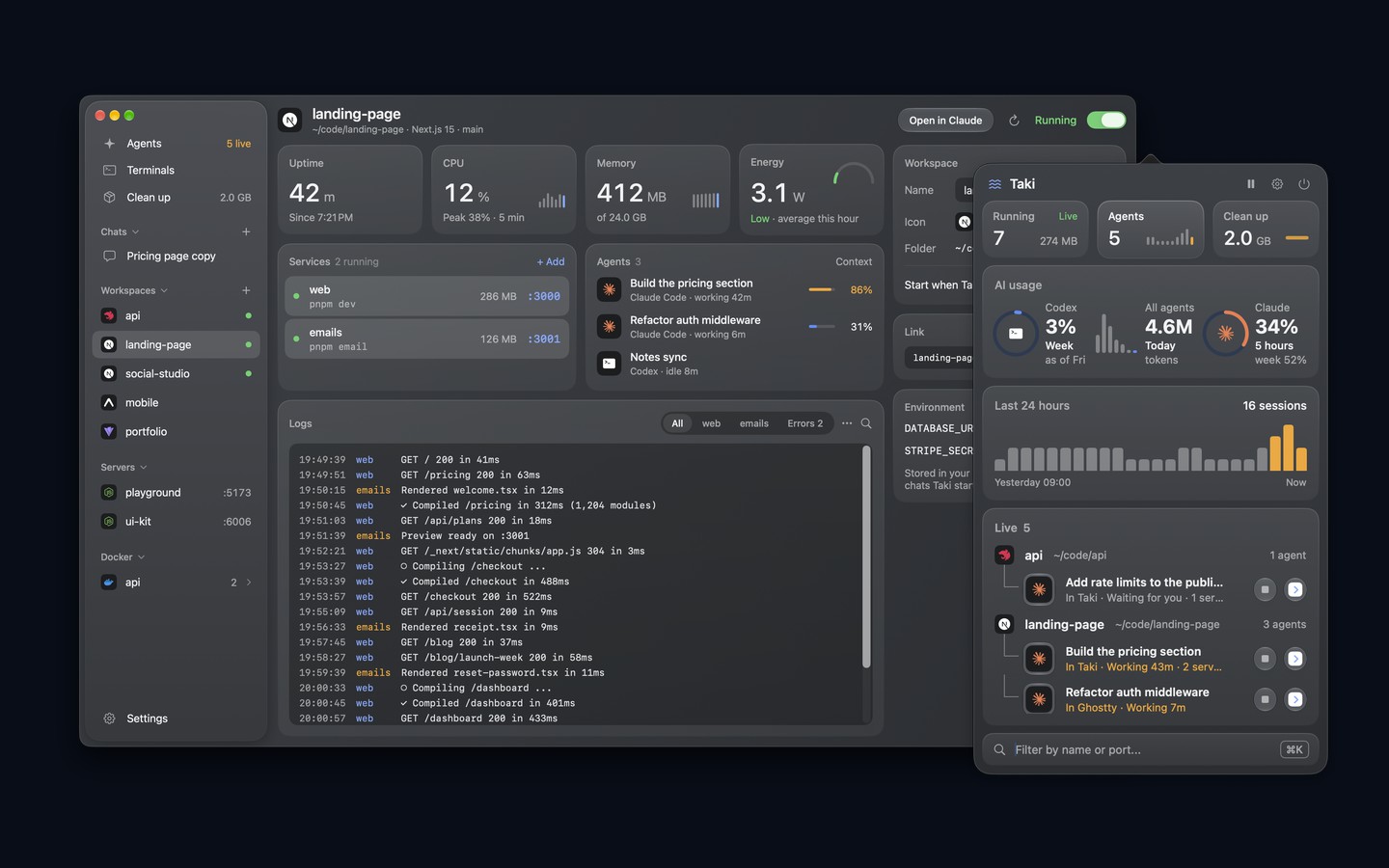
Taki is a native Mac app, written in Swift and SwiftUI. It finds every live Claude Code, Codex and Cursor session on the Mac, wherever it was started, and puts each one next to the project it is working on.
- Every agent in one list. You see what each agent is doing (working, idle or waiting for you), for how long, and how much of its context window is used. Open takes you to the exact Terminal or iTerm tab it runs in. Continue in Claude Code resumes the same conversation in a new tab. Stop ends it.
- Workspaces that find themselves. Any project with an agent, a dev server or a Docker compose stack running becomes a workspace on its own, with the framework's logo, its services, live logs coloured by service, uptime, CPU, memory and energy. Environment variables stay in the Keychain.
- Claude Code inside the app. Chat with Claude Code in any folder. It runs Claude Code itself, so your settings, hooks, skills and CLAUDE.md all apply, and permission prompts appear as cards you can allow or deny.
- Terminal tabs that scale. Shell, Claude Code and Codex tabs in one switcher that stays usable with fifteen tabs open, and each Claude tab resumes its own conversation after a relaunch.
- A menu bar panel. What is running, how many agents are live, your Claude plan limits and Codex usage, the last 24 hours, and a live tree of every agent by project.
- Clean up. Merged agent worktrees, stale build caches, old transcripts and processes left behind by finished agents, all moved to the Trash rather than deleted.
Why we built it native
A tool that watches everything on your Mac has to stay out of the way. Taki reads what is already there: the session files Claude Code keeps, the process tree, listening ports and Docker's container list. It reads them incrementally every few seconds and uses around 80 MB of memory doing it. There is no account, no analytics and no server. The only network traffic is what Claude Code itself sends when you chat.
Native also meant we could use what macOS gives us: the system's Liquid Glass on buttons, real window controls, light and dark appearance, five desktop widgets and a command palette you can open from any app.
Built in the open
The code, the brand files and the tests are all on GitHub. Build it with Xcode and XcodeGen in a couple of minutes, read how each part works, or open an issue. It joins the other tools we publish on our open source page, and you can read the full case study on our work page.
If your team needs software like this built for how you work, a native app, a dashboard or an AI feature that actually helps, tell us about your project.